RSF Names PM Modi Among 37 'Predators of Press Freedom' With Kim Jong-un, Imran Khan
'All that is left for Modi is to neutralise the media outlets and journalists that question his divisive methods,' RSF notes.
Prime Minister Narendra Modi. Photo: pmindia.gov.in
New Delhi: Prime Minister Narendra Modi is in the list of 37 heads of state or government that the global body Reporters Without Borders (RSF) has identified as ‘predators of press freedom’. The entry against Modi notes how his “close ties with billionaire businessmen who own vast media empires” has helped him spread his nationalist-populist ideology through continued coverage of his “extremely divisive and derogatory” speeches.
India is ranked 142nd out of 180 countries in RSF’s 2021 World Press Freedom Index. RSF is the world’s biggest NGO specialising in the defence of media freedom, which is regarded as a basic human right to be informed and to inform others.
Modi joins the likes of Pakistan’s Imran Khan, Saudi Arabia’s crown prince Mohammed bin Salman, Myanmar’s military head Min Aung Hlaing and North Korea’s Kim Jong-un, along with 32 others who “trample on press freedom by creating a censorship apparatus, jailing journalists arbitrarily or inciting violence against them when they don’t have blood on their hands because they have directly or indirectly pushed for journalists to be murdered.”
This is the first time since 2016 that RSF is publishing such a list. Seventeen of the heads identified as ‘predators’ are new entrants. Thirteen of the 37 in the list are from the Asia-Pacific region.
Seven of the list’s world leaders have been a part of it since it was first published in 2001 and include Syria’s President Bashar al-Assad, Iran’s Ali Khamenei, Russia’s Vladimir Putin and Belarus’s Alexander Lukashenko. The latter has gained credence as a ‘predator’ since the dramatic rerouting of a plane to capture critique and journalist Roman Protasevich.
Bangladesh’s Sheikh Hasina and Hong Kong’s Carrie Lam are the two women identified as ‘predators’.
For each of the predators, RSF has compiled a file identifying their ‘predatory method,’ their press release notes.
The list also highlights how each ‘predator’ censors and persecutes journalists, and their ‘favourite targets’ – the kinds of journalists and media outlets they go after, along with quotations from speeches or interviews in which they ‘justify’ their predatory behaviour.
Modi’s entry notes that he has been a “predator since taking office” on May 26, 2014 and lists his ‘predatory methods’ as ‘national populism and disinformation’. His favourite targets, RSF says, are ‘sickulars’ and ‘presstitudes’. The former is a word which the Hindu rightwing and supporters of Modi’s Bharatiya Janata Party use to slam viewpoints that are ‘secular’ – a word which is also in the Preamble of the Indian constitution – and not ostensibly rightwing Hindu-adhering. The latter is an amalgamation of ‘press’ and ‘prostitute’ – intended to indicate with the help of misogyny that media critical of Modi is a sellout.
The following is how the RSF describes Modi’s impact on the free press:
After becoming Gujarat’s chief minister in 2001, he used this western state as a laboratory for the news and information control methods he deployed after being elected as India’s prime minister in 2014.
His leading weapon is to flood the mainstream media with speeches and information tending to legitimise his national-populist ideology. To this end, he has developed close ties with billionaire businessmen who own vast media empires.
This insidious strategy works in two ways. On the one hand, by visibly ingratiating himself with the owners of leading media outlets, their journalists know they risk dismissal if they criticise the government. On the other, prominent coverage of his extremely divisive and derogatory speeches, which often constitute disinformation, enables the media to achieve record audience levels.
All that is left for Modi is to neutralise the media outlets and journalists that question his divisive methods. For this, he has a judicial arsenal with provisions that pose a major threat to press freedom. For example, journalists risk the possibility of life imprisonment under the extremely vague charge of sedition.
To round off this arsenal, Modi can count on an army of online trolls known as “yodha” (the Hindi word for “warriors”), who wage appalling hate campaigns on social media against the journalists they don’t like, campaigns that almost routinely include calls for the journalists to be killed.
The note also points out the murder of journalist Gauri Lankesh, in 2017, was a significant victim of Hindutva, “the ideology that spawned the Hindu nationalist movement that worships Modi.”
It also notes like women journalists like Rana Ayyub and Barkha Dutt, who have been critical of Modi, receive the brunt of virulent attacks, including doxxing and call for gang-rapes.
As a rule, any journalists or media outlets that question the prime minister’s national-populist ideology are quickly branded as “sickular” – a portmanteau of “sick” and “secular” – and are targeted by “bakht,” Modi devotees who bring lawsuits against them, defame them in the mainstream media and coordinate online attacks against them.
Recently, RSF had been critical of the “absurd charges” of “criminal conspiracy” brought against The Wire, Twitter India, and journalists Rana Ayyub, Saba Naqvi and Mohammed Zubair in connection with tweets and reports on an attack against a Muslim elderly man in Ghaziabad.
Measure
Measure
Get a free Evernote account to save this article and view it later on any device.
Hilarious Story Behind IAS Officer's Pic With Husband
"May 10, 2016. Results of Civil Service Exam 2015 was expected to be out and I was roaming with Arun Sudarsan to not stress over it," wrote IAS Chandni Chandran.
In 2016, IAS Chandni Chandran's pic with boyfriend appeared in a newspaper.
The year was 2016. Chandni Chandran, an IAS officer today, was then only one of the thousands of aspirants who had appeared for the Civil Service Exam 2015 and were awaiting their result. To beat the stress around the time results were expected, Ms Chandran decided to take a walk with then-boyfriend, now-husband Arun Sudarsan . What followed is a hilarious story that anyone who has ever sneaked out with a boyfriend will find quite relatable. Ms Chandran took to Twitter on Tuesday to reveal the story.
"May 10, 2016. Results of Civil Service Exam 2015 was expected to be out and I was roaming with @mrarunsudarsan to not stress over it," she wrote on the microblogging platform, tagging her husband. "I didn't make it," she added.
Ms Chandran eventually cleared the UPSC exams next year and belongs to the 2017 IAS batch. She is currently posted as sub-divisional magistrate of Kanchanpur, North Tripura.
In her Twitter thread, she recalls that while she did not clear the highly-competitive exam that year, her photo did appear in a newspaper alongside pictures of UPSC toppers. "Next day newspapers were filled with pics of toppers and @timesofindia published this pic of us!" she wrote, sharing a picture that shows her walking in the rain with Mr Sudarsan. The picture, which shows the two of them sharing an umbrella, was published in a small piece about rains in the city.
"Arun called ToI and complained as we weren't married then," the IAS officer wrote. For her part, Ms Chandran took it as a sign that her photo was destined to appear in a newspaper filled with UPSC toppers. "I can happily walk towards any destination with someone holding an umbrella and looking out for me with love unbound when I take each step," she wrote.
So what happened when the picture appeared in the newspaper? In the comments section, Ms Chandran explained why they had taken issue with the photo and complained to the publication.
"Nothing illegal! Just that such pics create uncomfortable conversations at home," she wrote.
She also explained why she was reminded of the photograph recently and decided to tweet about it. "I made it and we got married," wrote Ms Chandran. She said she was recently reminiscing about the picture and her husband contacted the photographer, Rakesh Nair, who graciously sent them a copy.
India economy: Seven years of Modi in seven charts
By Nikhil Inamdar and Aparna Alluri BBC News, Delhi
Published
IMAGE COPYRIGHT GETTY IMAGES
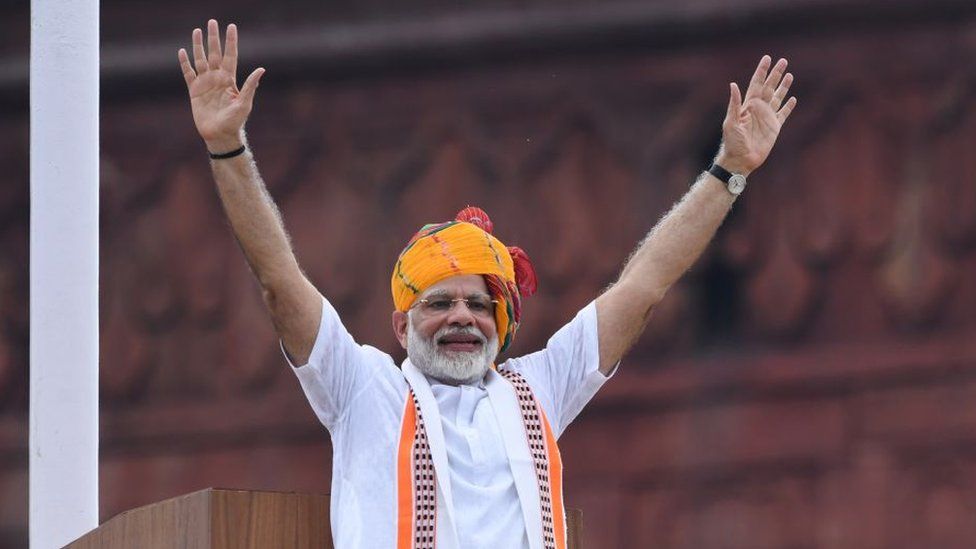
Narendra Modi stormed India's political stage with grand promises - of more jobs, prosperity and less red tape.
His thumping mandate - in 2014 and again in 2019 - raised hopes of big bang reforms.
But his economic record, in the seven years he's been prime minister, has proved lacklustre. And the pandemic battered what was an already under-par performance.
Here's how Asia's third-largest economy has fared under Mr Modi, in seven charts.
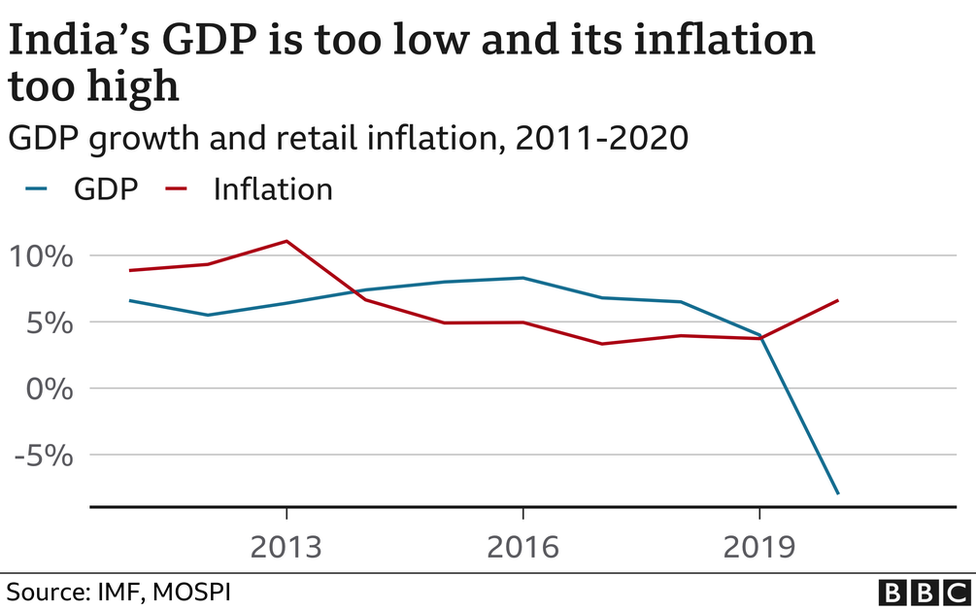
Mr Modi's avowed GDP target - a $5 trillion (£3.6 trillion) economy by 2025, or roughly $3 trillion after adjusting for inflation - is a pipe dream now.
Independent pre-Covid estimates for 2025 had touched $2.6 trillion at best. The pandemic has shaved off another $200-300bn.
Rising inflation, driven by global oil prices, is also a big concern, economist Ajit Ranade said.
But Covid is not solely responsible.
India's GDP - at a high of 7-8% when Mr Modi took office - had fallen to its lowest in a decade - 3.1% - by the fourth quarter of 2019-20.
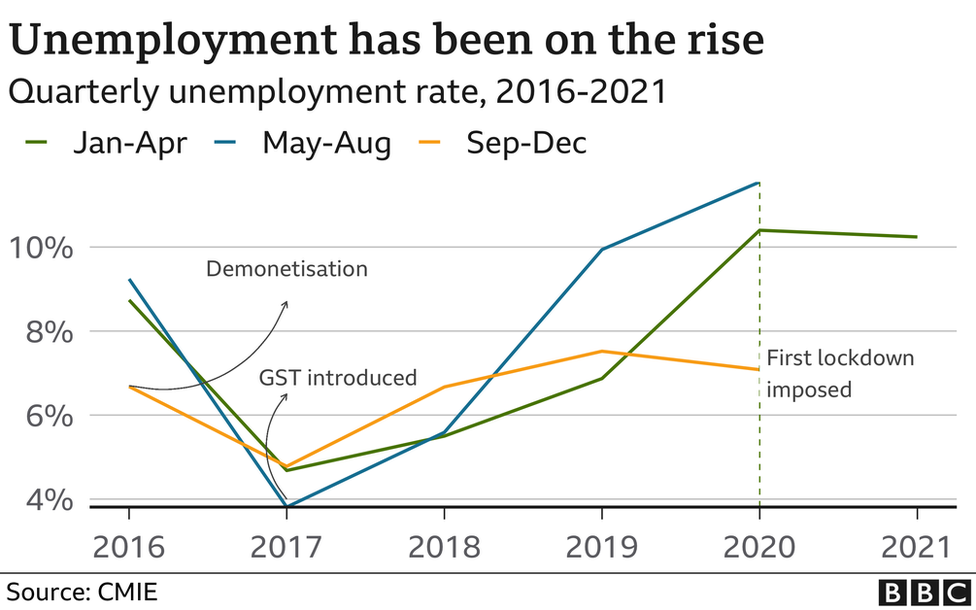
"India's biggest challenge has been a slowdown in investments since 2011-12," said Mahesh Vyas, CEO of the Centre for Monitoring the Indian Economy (CMIE). "Then, since 2016, we have suffered too many economic shocks in quick succession."
The currency ban, GST and intermittent lockdowns all reduced employment, he added.
Unemployment climbed to a 45-year high - 6.1% - in 2017-18, according to the last official count. And it has nearly doubled since then, according to household surveys by CMIE, a widely-used proxy for labour market data.
More than 25 million people have lost their jobs since the start of 2021. And more than 75 million Indians have plunged back into poverty, including a third of India's 100 million-strong middle class, setting back half a decade of gains, according to estimates by Pew Research.
Mr Modi's government has also created far short of the 20 million jobs the economy needs every year, Mr Ranade said. India has been adding only around 4.3 million jobs a year for the last decade.
India is not making or exporting enough
'Make in India' - Mr Modi's high-octane flagship initiative - was supposed to turn India into a global manufacturing powerhouse by cutting red tape and drawing investment for export hubs.
The goal: manufacturing would account for 25% of GDP. Seven years on, it's share is stagnant at 15%. Worse, manufacturing jobs went down by half in the last five years, according to the Centre for Economic Data and Analysis.
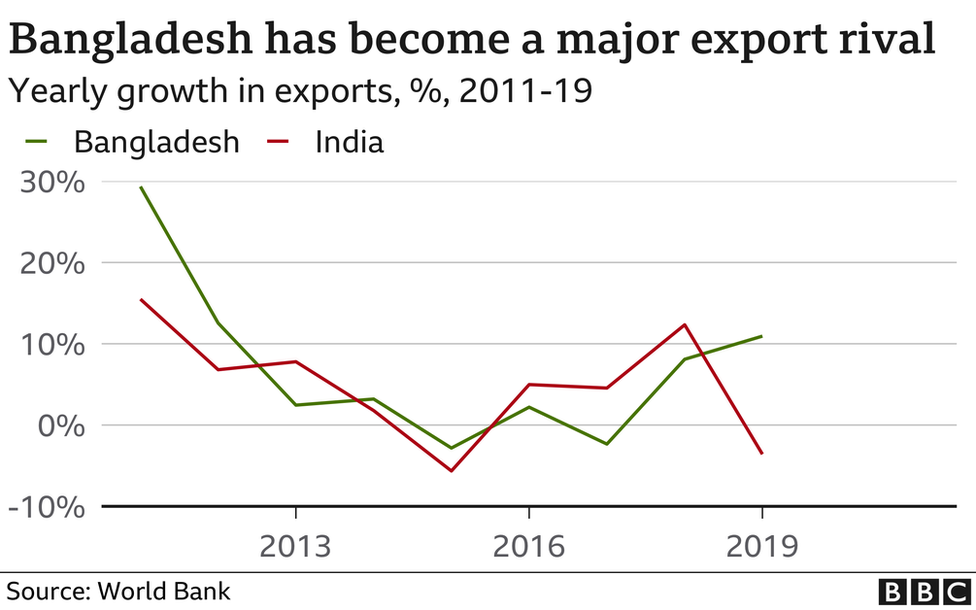
Exports have been stuck at around $300bn for nearly a decade.
Under Mr Modi, India has steadily lost market share to smaller rivals such as Bangladesh, whose remarkable growth has hinged on exports, largely fuelled by the labour-intensive garments industry.
Mr Modi has also hiked tariffs and turned increasingly protectionist in recent years - in tandem with his rallying cry for "self-reliance".
Infrastructure building is a rare bright spot
Mr Modi's government has been laying 36km (22 miles) of highways a day on average, compared to his predecessor's daily count of 8-11km, said Vinayak Chatterjee, co-founder of infrastructure firm Feedback Infra.
Installed renewables capacity - solar and wind - has doubled in five years. Currently at about 100 gigawatts, India is on track to achieve its 2023 target of 175 gigawatts.
Economists also largely welcomed Mr Modi's populist signature schemes - millions of new toilets to reduce open defecation, housing loans, subsidised cooking gas and piped water for the poor.
But many of the toilets aren't used or have no running water, and rising fuel prices have undone the benefit of the subsidy.
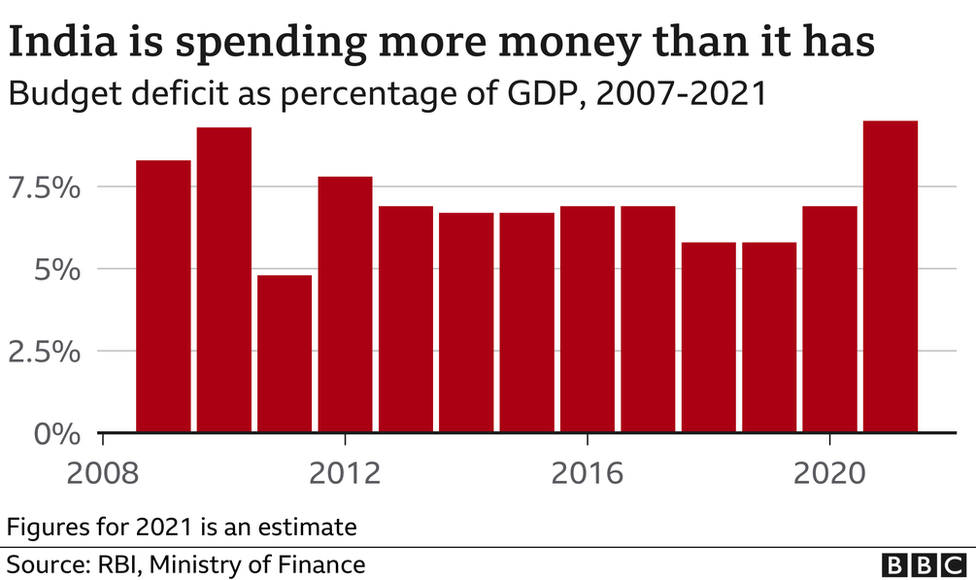
And the increased spending with no matching income from taxes or exports has economists worrying about India's ballooning fiscal deficit.
More people have joined the formal economy
This is Mr Modi's other big achievement.
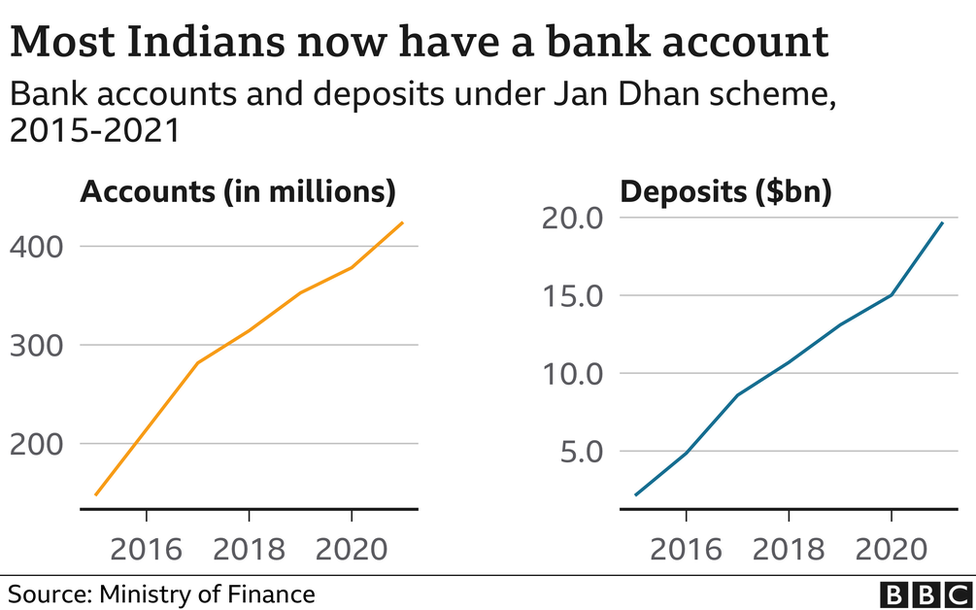
India has leapfrogged towards becoming a global leader in digital payments, thanks to a government-backed payment system. Mr Modi's Jan Dhan scheme has enabled millions of unbanked poor families to enter the formal economy with "no-frills" bank accounts.
Accounts and deposits have risen - a good sign, although reports suggest many of these accounts lie unused.
But economists say this is a huge step in the right direction, especially since it allows the direct transfer of cash benefits, cutting out middlemen.
Healthcare spending is dismal
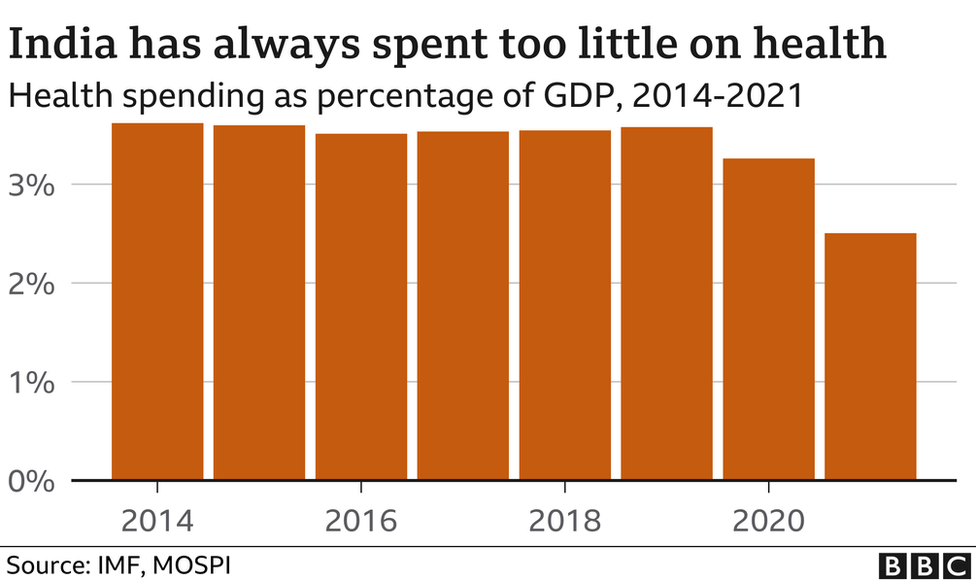
"Like previous governments, this one has continued to neglect healthcare. India has among the lowest levels of public spending on healthcare in the world," economist Reetika Khera said.
Experts say the emphasis is on tertiary care at the expense of preventive or primary care.
"This is hurtling us towards a US-style health system which is expensive and has poorer health outcomes in spite of that," Ms Khera added.
"It was long awaited but more resources need to go into it," said public health expert Dr Srinath Reddy. India needs to use Covid as a wake-up call to invest heavily in strengthening primary healthcare, he added.
Too many still work in farming
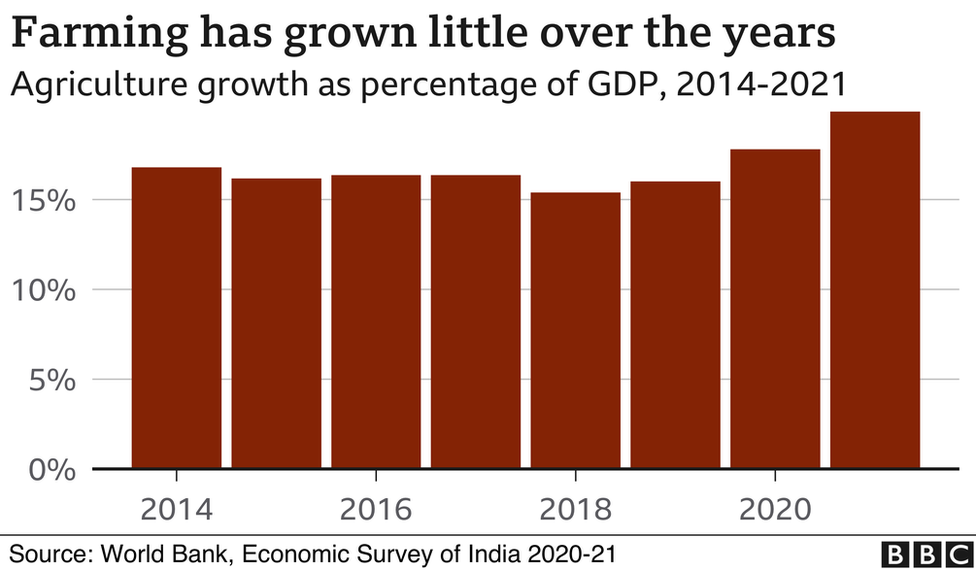
Farming employs more than half of India's working-age population but contributes too little to GDP.
Mr Modi, who had promised to double farm incomes, insists that's not true.
But experts say piecemeal reforms will achieve little - the government instead needs to spend to make farming more affordable and profitable, economist Professor R Ramakumar said.
"Demonetisation destroyed the supply chains, some irreparably, and GST led to a rise in input prices in 2017. The government has also done very little to alleviate the pain of 2020 [Covid lockdowns]," he added.
Mr Ranade said the solution partly lies outside farming: "Agriculture will do well when other sectors are able to absorb the surplus labour."
But that will only happen when India sees a revival in private investment - now at a 16-year low, according to CMIE - and possibly the biggest economic challenge Mr Modi faces.